
Moon Phases
Tuesday, March 31, 2026
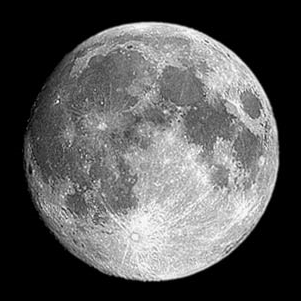
Waxing Gibbous 96% illuminated
Rise: 6:01 PM
Set: 5:47 AM
Eye on the Night Sky, June 18, 2026
Thursday, June 18, 2026
Today:
With the Summer Solstice but three days hence, you might think that the Sun will pass directly overhead. It’s true that the Sun reaches its highest point at our latitude on the Summer Solstice, though it runs just shy of 70 degrees above the southern horizon near 1:00 PM. To see the Sun directly overhead, you would need to travel south to the line on the globe marked the Tropic of Cancer, the northernmost point at which this happens on the Summer Solstice.
Friday:
At dusk this evening, the Moon appears about a third of the way up in the west-southwest. As the Moon lowers toward the western horizon, a companion will emerge from the evening twilight at around 9:40. This is the star Regulus, the brightest in the constellation Leo. Looking farther toward the horizon in the west-northwest, the two align well with Venus, Jupiter, and Mercury.
Saturday:
At 11 PM, look for the bluish-white star Vega, high in the east. It is also known as Alpha Lyrae, the brightest star in Lyra, the Harp, as well as being the highest star in the Summer Triangle, Altair and Deneb. Appearing lower in the sky is perhaps a little strange for these two stars, as each is the brightest star within a constellation denoting a bird: The Eagle, in the case of Altair; and The Swan, in the case of Deneb.
Start Chart:
Total Lunar Eclipse
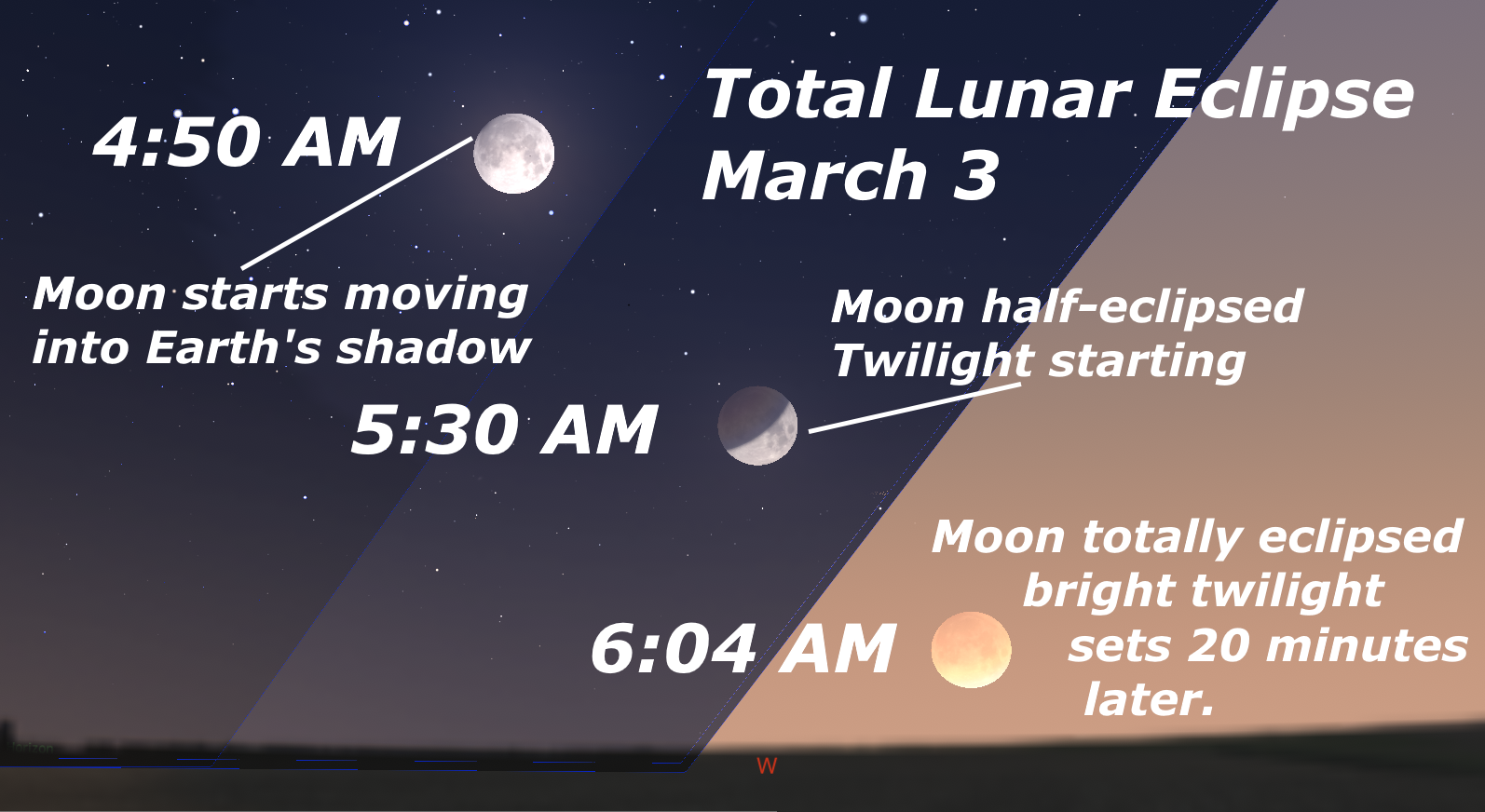
The Moon passes into the Earth’s shadow early Tuesday morning, March 3rd, 2026.
The Moon moves into the Earth’s shadow late at night on Tuesday, March 3rd, just as twilight increases. By the time the Moon is fully eclipsed, it becomes difficult to see in the brightening twilight, and it sets only 20 minutes after the eclipse is total.
The Earth’s rotation causes the stars, as well as the Moon, to rise in the east and set in the west. The Moon’s orbital motion, however, goes the opposite way, with the Moon actually moving from west to east, but much, much more slowly. This means the Moon’s expected motion, lowering toward the western horizon, comes from the Earth’s rotation. The Moon’s actual orbital motion causes it to move into the Earth’s shadow from lower right to upper left. This explains why the shadow starts on the Moon’s upper left, and progresses to the lower right.
Lunar eclipses aren’t rare, but they are also not frequent. The next Total Lunar Eclipse visible here is in June 2029, followed by another in December of 2029.

This program is a partnership between the Fairbanks Museum and Vermont Public.